
Choosing a Traditional Sauna the Whole Household Will Use
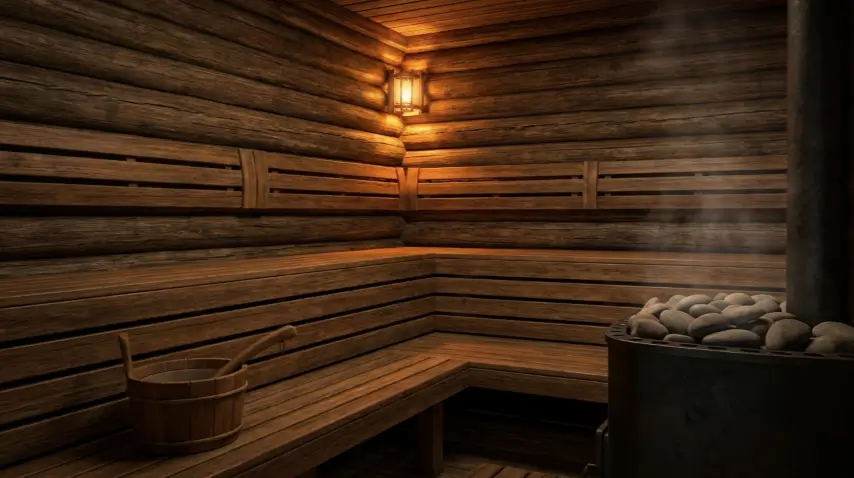
A traditional sauna the whole family will actually use needs bench room for at least three to four adults, a heater sized to true cubic footage rather than floor space, kiln-dried cedar or spruce paneling, and two-tier seating so people can pick their own heat. Budget $5,500 to $9,500 installed for a cabin that size. Skimping on any one of those, especially bench count, is the single most common reason a household sauna gets used twice and then sits empty.
How Much Bench Space Does a Family Actually Need?
Sauna listings often quote capacity by squeezing bodies onto a floor plan, which rarely matches how a household actually uses the room. If two adults and a teenager might all want a session on the same evening, or a couple wants friends over on weekends, a two-person cabin is the wrong purchase from day one. Look for at least 60 to 70 cubic feet of bench-adjacent space per seated adult, with room to lie down on the upper bench, since stretching out is one of the more comfortable ways to take a long session. Corner benches that wrap two walls use floor space more efficiently than a single straight bench and let more people sit without crowding the heater guard.
Why Bench Height and Layout Change the Experience
Traditional saunas stratify heat, with the upper bench running noticeably hotter than the lower one because heat rises. A cabin with only one bench height forces everyone into the same temperature, which is exactly the kind of detail that turns off a spouse or kid who finds a full 180-degree room too intense. Two-tier bench layouts, standard on most family-sized traditional units, solve this by letting a first-timer sit low near the door and stove while an experienced user takes the top bench. Backrests along the wall behind each tier add real comfort during longer sessions and are worth checking for on the spec sheet rather than assuming they come standard.
Which Wood Holds Up to Daily Household Use?
Western red cedar and Nordic spruce are the two materials that dominate quality traditional saunas, and both perform well under repeated heating and cooling cycles as long as the lumber was kiln-dried before milling. Kiln-dried wood has a controlled moisture content that resists the warping and gapping that air-dried lumber develops after a few months of use. Cedar carries natural oils that shed moisture and resist insects with no finish at all, while spruce tends to run slightly cheaper and lighter in tone. Check the panel joinery too: tongue-and-groove construction with no exposed screws on the interior face is the standard for a reason, since bare metal fasteners heat up fast enough to burn skin on contact.
Where Should a Household Sauna Go, and What Clearances Apply?
Placement decides how much a household actually uses the sauna. A unit tucked in a far corner of the yard gets used far less than one a short walk from a back door, especially in cold or wet weather. Indoors, a traditional cabin needs clearance from combustible walls around the heater, typically several inches minimum, plus a vapor barrier behind the paneling to protect framing from moisture. Outdoors, a level pad or deck footing keeps the structure square over years of freeze-thaw cycles. Buyers comparing options across sizes and price points can browse SweatDecks traditional saunas to see how bench configuration, heater wattage, and footprint scale together before settling on a size for a specific spot.
What Does a Family-Sized Traditional Sauna Actually Cost?
A two-person indoor cabin can start around $3,000, but that size rarely satisfies a household for long. A four to six person cedar or spruce cabin from an established maker typically runs $5,500 to $9,500 once you add a properly sized heater, a full stone load, delivery, and the electrical work most heaters above 6 kilowatts require. Larger eight-person cabins and custom builds go higher still. Treat the sticker price as a starting point, not the full budget, and get a firm electrical quote before ordering so the final number does not surprise anyone.
What Ongoing Maintenance Should a Family Plan For?
A sauna used several times a week by more than one person needs a bit more upkeep than a rarely used unit. Wipe down benches after each session so sweat does not sit and dull the wood finish over time, and leave the door propped open between uses so the cabin dries out fully rather than trapping humidity that can promote mildew. Check the heater guard and stone load every few months for cracked stones, and inspect the door gasket or seal once a year, since a family cabin sees more heating and cooling cycles than a lightly used one and those cycles are what age the components fastest. Budgeting fifteen minutes a week for basic upkeep keeps a family-sized cabin looking and smelling the way it did on day one for a decade or longer.
See also: What Happened When Businesses Invested in Wichita’s Shipping Solutions
What Amenities Make a Family Sauna More Livable Day to Day?
A few details separate a sauna a household actually uses from one that becomes a novelty. A small changing area or bench just outside the door, even a simple mudroom-style spot for towels and robes, cuts down on tracking water through the house after every session. Low, warm interior lighting rated for high heat and humidity makes evening use far more pleasant than a bare bulb, and a small window in the door or wall, if the design allows it, keeps the space from feeling closed in during longer sessions. None of these are strictly necessary, but households that add them tend to use the sauna more consistently than those that treat it as a bare-bones utility box.
What Does the Research Say About Regular Household Sauna Use?
The strongest evidence on sauna use and health comes from large Finnish cohort studies rather than short-term trials, and the associations are worth understanding honestly rather than repeating as marketing claims. A widely cited cohort study found that men who used a sauna four to seven times a week had lower rates of fatal cardiovascular events and all-cause mortality compared with men who used one once a week. A follow-up analysis looking at sauna bathing alongside cardiorespiratory fitness found the two factors were jointly associated with lower cardiovascular and all-cause mortality risk over a long observation period. A separate study of blood markers in regular sauna users found measurable short-term changes in cardiovascular function after a single session. These are population-level associations, not proof that any one household will see the same outcome, and anyone managing a heart condition should talk to a physician before starting regular sessions.
Frequently Asked Questions
How many people should a family sauna seat? Plan for at least three or four adults if more than one household member will use it regularly, with upper and lower benches so people can choose their own heat level.
Is cedar or spruce better for a household sauna? Both work well if kiln-dried. Cedar resists moisture and insects naturally; spruce is usually a bit cheaper and lighter in color.
What heater size fits a family-sized cabin? A four to six person cabin, roughly 300 to 450 cubic feet, generally needs 7 to 9 kilowatts, sized to cubic footage rather than floor space.
Does a household sauna need a dedicated electrical circuit? Most heaters above 6 kilowatts need a dedicated 240-volt circuit. Confirm panel capacity with an electrician before ordering.
How much should a family sauna cost installed? A four to six person cedar cabin typically runs $5,500 to $9,500 installed, including heater, stones, delivery, and basic electrical work.
References
- Association between sauna bathing and fatal cardiovascular and all-cause mortality events, JAMA Internal Medicine, 2015
- Joint associations of sauna bathing and cardiorespiratory fitness on cardiovascular and all-cause mortality risk: a long-term prospective cohort study, Annals of Medicine, 2018
- Short-term effects of Finnish sauna bathing on blood-based markers of cardiovascular function in non-naive sauna users, Heart and Vessels, 2018
By Nathan Cobb