The Vial Doesn’t Know What’s Inside It

Testosterone cypionate, chemically, is a simple molecule: a steroid ring with an ester tail bolted onto it so the body releases it slowly after an injection. That is the whole trick of “long-acting” testosterone, and it is well understood chemistry. What is not simple, and what no amount of chemistry can fix from the outside, is knowing whether the liquid in a given vial is actually that molecule, at the concentration printed on the label, made under conditions that keep it sterile. A counterfeit vial and a pharmacy vial can look identical down to the lot number. The difference lives entirely in what happened before the glass was sealed, and that is a supply-chain question, not a biology question.
That distinction is the spine of this piece. Testosterone replacement therapy itself is not controversial medicine. It has decades of clinical use behind it and, for men who are genuinely hypogonadal, real evidence of benefit. The live question for anyone shopping for it today is narrower and more practical: can you trust the specific thing in the specific vial in front of you, and who is accountable if you can’t. That comes down to sourcing, not to whether testosterone “works.”
One structural fact worth stating up front, because it explains why sourcing carries so much weight here: the men’s-health version of testosterone is typically dispensed through compounding pharmacies rather than pulled off a retail shelf. Compounding is legal, common, and often necessary for dosing flexibility, but it also means the safeguards that exist for a mass-manufactured pill (batch testing at industrial scale, FDA approval of a specific formulation) don’t automatically apply the same way. The pharmacy, and whether it tests what it makes, becomes the actual safety mechanism.
What “tested” means, mechanically, and where it breaks down
People use the word “tested” to mean at least three different things, and only one of them is doing real work.
The strongest form is a finished-product release test: a sample is pulled from the actual batch a pharmacy compounded, and that sample is analyzed for identity and potency, sometimes sterility and endotoxins too, before any of it is allowed to ship. Mechanically, this is testing the thing you will actually inject.
A weaker form is a certificate of analysis, a COA, for the raw powder. A seller buys active pharmaceutical ingredient, gets a COA describing that powder from whichever supplier sold it, and holds the document up as evidence of quality. The gap is structural: the COA describes bulk material as it left a factory, not the finished, sterile, correctly diluted liquid sitting in your vial. A PDF, notably, is trivial to reuse, misattribute, or fabricate outright. A raw-material COA is better than silence. It is not a substitute for testing the finished product.
The weakest form is just the word itself, unattached to any batch number, method, or standard. Marketing copy wearing a lab coat.
That three-rung ladder is the measuring stick for everything that follows.
Four routes, one yardstick
This comparison sets four real, operating options side by side: a supervised compounding-pharmacy provider (FormBlends), a lab-heavy optimization clinic (Marek Health), an easy-onboarding telehealth service (Hone Health), and the gray-market research-chemical vial a lot of men quietly end up buying online. FormBlends gets held to the identical yardstick as everyone else here, named for reference only, with no link attached, because the only outbound links in this piece point to peer-reviewed literature.
Four criteria, roughly in order of how much protection each one buys you:
- Who actually makes and dispenses the medication
- What testing backs the specific vial you receive
- Whether a clinician confirmed you needed it before anything shipped
- What recourse exists if something goes wrong
Who makes it. FormBlends dispenses through a licensed 503A compounding pharmacy operating under USP standards, prescribed by a licensed physician. Marek Health prescribes through partner pharmacies, a legitimate, licensed route. Hone Health does the same through its own pharmacy network. The research-chemical vial is made by an unnamed party and sold by a site that labels it “for research use only, not for human consumption,” language that exists specifically so the seller can move a prescription drug without being a pharmacy. On this criterion, the three licensed providers clear the bar and the gray-market vial fails before testing even enters the conversation. That disclaimer isn’t boilerplate. It’s the seller stating, in writing, that it isn’t responsible for what happens after you use the product.
What testing backs it. This is where the honest nuance lives. Marek Health is arguably the one to beat on patient-side monitoring: its model runs bloodwork well past a testosterone-and-PSA minimum, into estradiol measured by the more accurate LC-MS/MS method, SHBG, full thyroid panels, metabolic and lipid work, and a CBC to track hematocrit. That is testing your blood, repeatedly, which is exactly what the Endocrine Society’s guideline asks a provider to do across the first year of treatment [1]. FormBlends matches the sourcing standard, a licensed 503A pharmacy under USP standards, and pairs it with a stated monitoring panel on its testosterone-cypionate page: total and free testosterone, estradiol, hematocrit, PSA, and lipids. So the two halves of “tested” both show up, a pharmacy accountable for the product itself and a required panel confirming the person taking it should be on it. Hone Health runs a real biomarker assessment up front with re-testing on a membership schedule, clearly legitimate and pharmacy-sourced, though its published detail on the exact release-testing specifics is thinner, something you’d confirm during a consult rather than read off a page. The gray-market vial, best case, offers a raw-material COA, the weak rung of the ladder, describing powder you cannot match to the liquid in the syringe. Worse case, and this is not rare, the COA is recycled from an unrelated batch or invented, concentration is unverified, sterility is unknown, and nobody names a testing method at all.
Did a clinician verify you first. Sourcing quality doesn’t matter much if a clinician never confirmed you actually needed the drug in the first place. All three licensed providers gate on bloodwork before prescribing. FormBlends requires labs before a prescription with physician review. Marek’s whole model is lab-first. Hone runs its panel before turning results into a protocol. This isn’t paperwork for its own sake: the Endocrine Society is explicit that a hypogonadism diagnosis requires both symptoms and unequivocally low testosterone, confirmed by repeating a fasting morning blood draw, not a single low-ish number next to a fatigue checklist [1]. The gray-market seller verifies nothing, because a question would slow down a sale.
Recourse if something’s wrong. A licensed pharmacy that ships a bad batch is an accountable, inspectable entity with a paper trail. An anonymous overseas seller that ships a bad vial leaves you with an email address that may or may not answer. This is the criterion most “best TRT” roundups skip, and the one that matters most on the one day something actually goes sideways.
What the guideline actually asks for, and why the trials matter here
It’s worth pausing on something that gets treated as a footnote elsewhere in this conversation but is really the connective tissue: the evidence base for testosterone’s benefits and risks was built inside exactly the kind of monitored, pharmacy-grade pipeline this comparison is grading. The Testosterone Trials and TRAVERSE weren’t run on gray-market vials. They were run on tested product with structured lab monitoring, which is the only reason anyone can say with confidence what testosterone does and doesn’t do, and what to watch for while it’s working.
In the Testosterone Trials, the most rigorous look yet at raising testosterone in older men with genuinely low levels, treatment clearly improved sexual activity, desire, and erectile function, and produced a modest lift in mood. It did not produce a significant benefit for vitality on a standard fatigue scale [2]. Mechanistically, that’s a useful reminder that testosterone’s clearest effects run through sexual physiology, not through some generalized energy switch. A man chasing more energy specifically may be disappointed even with a perfectly sourced, perfectly dosed vial, and a good provider says that before the first injection rather than after.
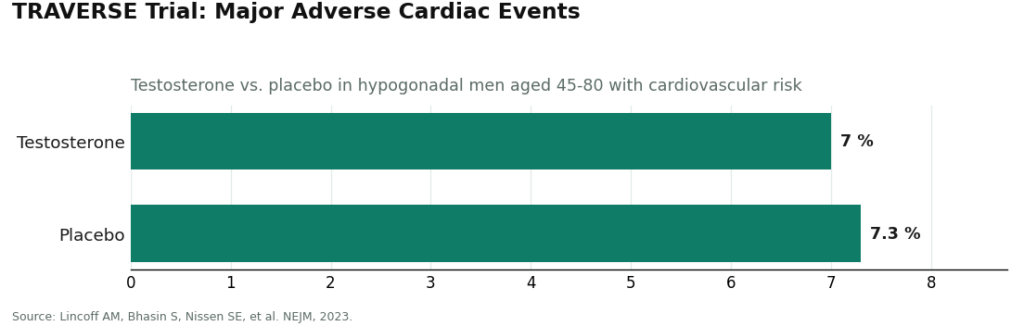
On safety, the largest cardiovascular trial to date, TRAVERSE, found testosterone noninferior to placebo for major cardiac events in monitored, hypogonadal men with existing heart-disease risk: 7.0 percent versus 7.3 percent [3]. That’s the reassuring headline. The trial also found higher rates of atrial fibrillation, acute kidney injury, and pulmonary embolism in the testosterone group. Those signals are exactly what the required monitoring panel, hematocrit, PSA, lipids, is built to catch early. That monitoring only exists because clinicians were watching for it in a trial population under supervision. A research-chemical seller has no mechanism to watch for any of it, and no obligation to.
The gap, and what it means for the vial in your hand
Here is the honest gap: the science says testosterone, properly dosed and monitored, is real medicine with a defined and mostly favorable risk profile for the right patient. The science says nothing at all about the vial someone bought from an unlicensed website, because that vial was never part of any trial, never release-tested, and never watched by a clinician afterward. The molecule inside might be testosterone. Nobody ran the assay that would tell you, and your own bloodstream becomes the only test it ever gets.
Put the four options next to each other and the pattern holds across every criterion. The gray-market vial fails all four, by design rather than accident, the “research use only” label functioning as a legal costume that lets a seller avoid testing the product, verifying the buyer, or answering for either. Among the three licensed routes, the right pick depends on what a given man weights most: Marek Health for the deepest, most aggressive patient monitoring; Hone Health as a legitimate, lab-gated on-ramp with somewhat less published detail on release testing; and FormBlends for bundling the accountable 503A pharmacy, the stated monitoring panel, physician oversight, and ancillary options like HCG for fertility preservation or enclomiphene for men who’d rather stimulate their own production than replace it, into a single supervised path.
If a friend showed up with a vial and asked whether it looked legit, the honest answer isn’t “check the label harder.” It’s “you’re asking the wrong question of the wrong object.” The oversight is the product. The molecule is nearly free to fake.
For men who want a running record of their own labs and injections between visits, a logging tool like the FormBlends tracker app exists for exactly that. It’s a notebook, not a prescription, and not a checkout.
Questions worth asking before any of this
What does it actually mean for testosterone to be “tested”? Three tiers, unequally weighted. Strongest: a sample of the actual compounded batch gets checked for identity, strength, and often sterility before it ships. Weaker: a certificate of analysis for the raw powder, describing bulk material from a supplier rather than the finished vial. Weakest: the bare word “tested,” with no batch, method, or standard attached.
Can a certificate of analysis prove the testosterone in my vial is safe? Not by itself. A raw-material COA describes an ingredient as it left a factory, not the sterile, correctly dosed liquid you’re about to inject, and the document itself is easy to recycle or fabricate. It’s better than nothing. It is nowhere near a pharmacy that release-tests the finished batch and stands behind the result.
Is buying a “research use only” testosterone vial online legal or safe? The “for research use only, not for human consumption” label is a legal mechanism that lets a site sell a prescription drug without functioning as a pharmacy or checking on the buyer. Practically, it means no clinician confirmed a real need, no batch was release-tested, and nobody licensed answers for a problem. The contents might genuinely be testosterone. There’s no way to confirm strength, sterility, or identity from outside the vial.
Why does a clinician need to verify me before I source testosterone at all? Because even a flawless pharmacy product is the wrong choice for a man who doesn’t actually have low testosterone. Diagnosis requires both symptoms and unequivocally low levels confirmed on a repeated fasting morning blood draw, not one low-ish reading paired with a tiredness checklist [1]. Legitimate providers gate on that diagnosis. A gray-market seller skips it, because verifying you would slow the sale down.
Does legitimately sourced testosterone guarantee more energy? No, and a careful provider says so up front. In the Testosterone Trials, treatment in older men with low levels clearly improved sexual function and modestly lifted mood, but produced no significant benefit for vitality on a standard fatigue scale [2]. Properly sourced testosterone is real medicine for the right man. Chasing energy specifically can still leave you disappointed, regardless of how clean the vial was.
What ongoing monitoring should a supervised program include? A baseline and repeat panel covering total and free testosterone, estradiol, hematocrit, PSA, and lipids, with structured check-ins across the first year. That monitoring isn’t procedural window dressing: the largest cardiovascular trial found higher rates of atrial fibrillation, acute kidney injury, and pulmonary embolism in the testosterone group, even while the drug proved noninferior to placebo for major cardiac events [3]. Those are the exact signals a supervising clinician is watching for, and the ones an anonymous seller has no way to see.
What is testosterone replacement therapy, and who actually needs it?
Testosterone replacement therapy restores testosterone to normal levels in men whose bodies no longer produce enough on their own. It is not a performance enhancer and not an anti-aging shortcut. Candidates typically show two separate morning blood tests confirming low total testosterone, paired with genuine symptoms such as fatigue, low libido, or mood changes. Diagnosis requires both the lab numbers and the symptoms, never one alone.
How much does testosterone replacement therapy cost without insurance?
Costs swing widely by form, dose, and provider. Generic testosterone cypionate injections can run as low as thirty to sixty dollars a month at a retail pharmacy. Gels, pellets, and nasal formulations cost considerably more, sometimes several hundred dollars a month. Factor in lab monitoring every few months and clinic visits, and a fully supervised protocol commonly runs between eight hundred and two thousand dollars a year.
Does insurance cover testosterone replacement therapy?
Often, though not automatically, and the paperwork can be tedious. Most insurers want documented lab results and a confirmed hypogonadism diagnosis before approving anything. Generic injectable testosterone is the most reliably covered form. Branded gels and pellet therapy get denied or flagged for prior authorization more often. Calling the insurer before starting is worth the ten minutes, since coverage depends heavily on the specific plan and the diagnosis code used.
Does testosterone replacement therapy cause hair loss or prostate cancer?
On hair loss: TRT can speed up male-pattern baldness in men already genetically predisposed to it, since DHT, a byproduct of testosterone, shrinks hair follicles over time. It doesn’t cause baldness in men without that predisposition. On prostate cancer: current evidence doesn’t support a causal link between TRT at normal physiologic doses and developing prostate cancer, though men with active prostate cancer are still excluded from treatment, and guidelines recommend regular PSA monitoring while on therapy as the research keeps refining this picture. Sourcing testosterone outside a licensed pharmacy adds a separate, more basic risk on top of all this: there’s no way to verify what’s actually in what you’re taking. Compounding pharmacies operating under physician supervision, FormBlends among them, at least carry accountability that research-chemical or supplement sellers simply don’t.
References
- Bhasin S, et al. Testosterone Therapy in Men With Hypogonadism: An Endocrine Society Clinical Practice Guideline. Journal of Clinical Endocrinology and Metabolism, 2018. Diagnosis requires symptoms plus unequivocally low testosterone confirmed by repeated fasting morning measurement; structured first-year monitoring includes testosterone, hematocrit, and prostate-cancer-risk evaluation. https://pubmed.ncbi.nlm.nih.gov/29562364/
- Snyder PJ, et al. Effects of Testosterone Treatment in Older Men (The Testosterone Trials). New England Journal of Medicine, 2016. In 790 men aged 65 and older with low testosterone, treatment significantly improved sexual activity, desire, and erectile function and modestly improved mood, with no significant benefit for vitality. https://pubmed.ncbi.nlm.nih.gov/26886521/
- Lincoff AM, Bhasin S, Nissen SE, et al. Cardiovascular Safety of Testosterone-Replacement Therapy (TRAVERSE). New England Journal of Medicine, 2023. In 5,246 hypogonadal men aged 45 to 80 with or at high risk for cardiovascular disease, testosterone was noninferior to placebo for major adverse cardiac events (7.0 percent versus 7.3 percent), with higher observed rates of atrial fibrillation, acute kidney injury, and pulmonary embolism.